How to Plan for Peak Hour Traffic in Telecom Networks
Telecom networks are always sized for the busy hour, not daily averages. Here's how to find your peak traffic period, measure it accurately, and plan capacity for it.
> **Quick Answer:** The busy hour is the 60-minute period with the highest traffic load in your measurement period. Always size trunks and agents for the busy hour — planning to daily averages leads to systematic underprovisioning during your most critical period.
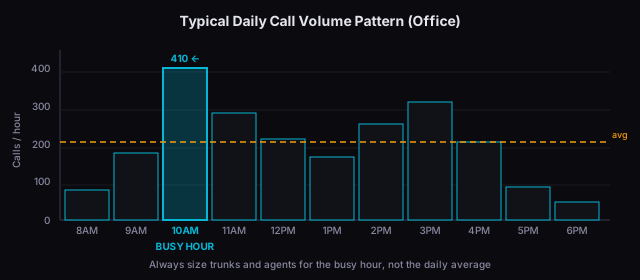
Traffic engineering has a golden rule: **size for the busy hour.** Every Erlang calculation — whether you're dimensioning trunk lines with Erlang B or calculating call center agents with Erlang C — uses busy-hour traffic as its input. Not average traffic. Not daily totals. The single busiest 60-minute period.
This guide explains why, how to find your busy hour, and how to plan for traffic patterns that shift over time.
Why the Busy Hour Matters
Consider two telephone systems, both handling 480 calls per day:
**System A:** Calls arrive evenly at 20 per hour across a 24-hour period.
**System B:** 400 calls arrive between 9 AM and 5 PM, with 200 of them packed into the 10–11 AM hour.
Both systems handle 480 calls per day. But they need very different amounts of infrastructure.
System A needs circuits for 20 calls per hour × 4-minute average call = 1.3 Erlangs. A handful of lines handles this easily.
System B needs circuits for 200 calls per hour × 4 minutes = 13.3 Erlangs. That requires 19 trunk lines at P.02.
If you mistakenly plan System B to daily average traffic (480/24 = 20 calls per hour), you'd build for 1.3 Erlangs and block the majority of calls during your peak hour.
ITU-T Definition of the Busy Hour
The International Telecommunication Union defines the busy hour in **ITU-T Recommendation E.501** as: *"The continuous 60-minute period during which the traffic intensity is at its maximum during the observation period."*
This is the "peak busy hour" — one hour, the highest single hour in the measurement period. Most network planning uses busy-hour data collected over 30–90 days to find a representative peak.
ITU-T also defines the **time-consistent busy hour** — the same clock-hour that shows the highest average traffic across many days. If your Tuesday 10 AM hour consistently shows the highest traffic over 4 weeks, that's your time-consistent busy hour. This is what most carriers use for annual capacity planning.
How to Find Your Busy Hour
Method 1: CDR Report Analysis
Your PBX or IP telephony platform generates Call Detail Records (CDRs) for every call. Group these by hour and count calls or sum call-seconds.
In most systems (Cisco CUCM, Avaya CM, FreePBX, 3CX, Microsoft Teams Phone):
1. Run a CDR extract for the last 30 working days
2. Group by date and hour
3. Find the max calls-per-hour cell in the resulting table
That's your busy hour. For a cleaner picture, average the top 5 hours across different days to smooth out unusual spikes.
Method 2: SIP Provider Concurrency Reports
If you use a hosted SIP provider, they usually provide a concurrent calls dashboard or report. This shows you the maximum simultaneous sessions at any point in time.
Note: peak concurrent calls is NOT the same as traffic intensity. If peak concurrency is 18 simultaneous calls, and your average call is 4 minutes, your traffic intensity is closer to 12–14 Erlangs, not 18. Don't size to peak concurrency — size to Erlangs.
Method 3: Carrier Traffic Reports
If you have a traditional PRI or T1 connection, your carrier can provide traffic reports from their measurement systems. These typically show hourly traffic in Erlangs or CCS directly. Request 90 days of busy-hour traffic history.
Seasonal and Weekly Traffic Patterns
Many businesses have traffic patterns that vary dramatically by day of week, month, or season.
**Day-of-week variation:**
Most offices see Monday and Tuesday as their busiest days for inbound calls. A business averaging 15 Erlangs across the week might hit 22 Erlangs on Monday morning. Size for Monday, not the weekly average.
**Monthly patterns:**
Financial services and utilities often see spikes around billing cycles. Healthcare sees Monday call volumes that are 40–60% higher than other days (weekend catchup). Retail spikes during promotions, holidays, and post-holiday return periods.
**Seasonal variation:**
Tax preparers peak in March–April. Heating oil companies peak in October–February. Travel companies peak in January (holiday booking) and June (summer planning). Identify your peak season's busy hour — it may be 3–5× your off-peak busy hour.
**How to handle seasonal variation:** Identify your peak month, find its busy hour, and size your network for that. If your peak season is dramatically higher than the rest of the year, consider flexible SIP trunking that lets you burst capacity seasonally rather than permanently provisioning for peak.
The Busy Hour in Call Center Planning
For call center staffing with Erlang C, busy-hour planning is even more critical because the Erlang C formula is highly sensitive to the ratio of agents to traffic intensity. A 10% increase in traffic can cause service level to drop 20–30 percentage points if you're near the occupancy threshold.
Standard call center practice:
1. **Planning interval:** Most WFM systems plan in 30-minute intervals, not 60-minute. Find your busiest 30-minute interval and double the call volume to get an hourly equivalent.
2. **Day-type planning:** Separate your historical data into day types (Monday, Tuesday–Thursday, Friday, Saturday, Sunday) and plan staffing for each day type's pattern.
3. **Forecast uplift:** Your Erlang C calculation should use a traffic forecast, not historical actuals. If you forecast 8% call volume growth over the next quarter, size for that future load.
4. **Buffer for forecast error:** Add 5–10% to your forecast before running Erlang C to protect against forecast under-estimates. It's cheaper to have a slightly over-staffed hour than to miss your service level target.
Worked Example: Retail Business
A retail company runs a customer service line. Their CDR analysis shows:
| Hour | Avg Calls/Hour (30-day avg) |
|------|-----------------------------|
| 9–10 AM | 280 |
| **10–11 AM** | **410** ← busy hour |
| 11 AM–noon | 380 |
| Noon–1 PM | 290 |
Their busy hour is 10–11 AM with 410 calls. Average call duration from CDRs: 195 seconds.
Traffic intensity: (410 × 195) / 3600 = **22.2 Erlangs**
Running this through our [Erlang B calculator](/erlang-calculator) at P.02: **30 SIP trunk channels needed.**
If they had used their daily average of 280 calls/hour: (280 × 195) / 3600 = 15.2 Erlangs → 22 trunks. They'd have 8 fewer trunks during their peak hour, blocking roughly 10% of calls. During their busiest time of day.
Find your busy hour. Plan for it. Everything else follows.