How to Calculate SIP Trunk Lines for Your Business
Size your SIP trunks correctly using Erlang B: find your busy-hour call volume, calculate traffic intensity, then apply the Erlang B formula for your blocking target.
> **Quick Answer:** Take your busy-hour call volume, multiply by average call duration in seconds, divide by 3600 to get Erlangs. Then use Erlang B to find how many SIP channels you need to keep blocking below your target — typically 2% for business telephony.
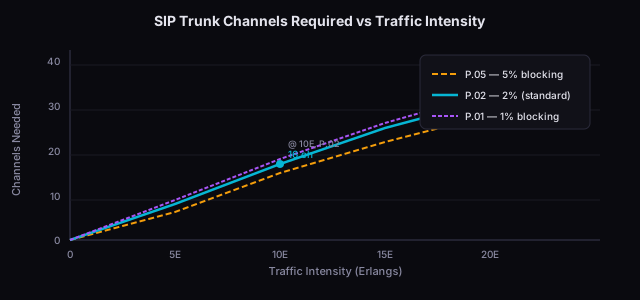
SIP trunks replaced physical T1 and PRI lines for most businesses over the past decade. But the math for sizing them hasn't changed — you still need Erlang B to get it right. Get the channel count wrong and you'll either overpay for unused capacity or block calls during peak hours, which is the kind of problem that shows up as customer complaints and dropped sales.
This guide walks through the exact process from raw call data to a channel count you can hand to your SIP provider.
Step 1: Pull Your Busy-Hour Call Volume
SIP trunk sizing is always based on your **busy hour** — the 60-minute period with the highest call volume. Don't use daily averages. If you handle 800 calls on a Tuesday and most of them arrive between 9 and 11 AM, your average of 33 calls per hour is irrelevant. Your 10 AM hour might show 180 calls.
Where to find your busy-hour data:
If you're a new business without call history, estimate conservatively. A 10-person office where everyone might be on a call simultaneously needs roughly 10 channels minimum, but you should factor in inbound calls from customers too.
Step 2: Determine Average Call Duration
Average call duration (also called Average Talk Time or ATT) is the mean length of a connected call in seconds, including any hold time during the call. Don't include ring time or post-call processing in this number — those don't occupy the trunk.
Typical values:
- **General business office:** 180–240 seconds (3–4 minutes)
- **Sales calls:** 300–600 seconds (5–10 minutes)
- **Brief order-taking or appointment scheduling:** 90–120 seconds
- **Technical support:** 480–900 seconds (8–15 minutes)
Pull this from the same CDR report. Filter out very short calls (under 10 seconds — usually misdials) and very long calls if they're outliers that skew the average.
Step 3: Calculate Traffic Intensity in Erlangs
Traffic intensity tells you the equivalent number of circuits occupied full-time. The formula:
**A = (Calls per hour × Average duration in seconds) / 3600**
**Example:**
- Busy hour: 240 calls
- Average duration: 210 seconds
- Traffic intensity: (240 × 210) / 3600 = **14 Erlangs**
14 Erlangs means you'd need 14 circuits running continuously for that hour to carry all calls with zero spare capacity. Since calls arrive randomly (not perfectly spaced), you need more than 14 channels.
Step 4: Apply Erlang B to Find Channel Count
The Erlang B formula calculates blocking probability for N channels carrying A Erlangs of traffic. You run it iteratively, increasing N until blocking falls below your target.
**Common Grade of Service targets:**
For 14 Erlangs at P.02 (2% blocking):
| Channels | Blocking Probability |
|----------|---------------------|
| 14 | 13.2% |
| 16 | 7.1% |
| 18 | 3.5% |
| **20** | **1.7%** ✓ |
You need **20 SIP channels** to serve 14 Erlangs with less than 2% blocking.
Our [SIP trunk calculator](/erlang-calculator) handles this automatically. Enter 240 for calls per hour, 210 for duration, 2 for target blocking, select Erlang B mode, and click Calculate.
Step 5: Add a Buffer for Growth
The Erlang B result gives you the channel count for today's traffic. SIP trunks are usually priced per channel or per bundle of channels. Plan for 6–12 months of growth by adding 10–20% to your calculated channel count, then round up to whatever bundle size your provider offers.
If your SIP provider sells in bundles of 5, and you calculated 20 channels, order 25 — giving you capacity for a 25% traffic increase before you need to re-provision.
Common Sizing Mistakes
**Using average traffic instead of busy-hour traffic.** If your daily average is 8 Erlangs but your peak hour hits 14 Erlangs, sizing for 8 Erlangs will block 13% of your calls during peak periods.
**Forgetting about inbound and outbound simultaneously.** SIP channels are bidirectional but finite. If you have 20 channels and 15 are carrying inbound calls, you only have 5 left for outbound. Most businesses mix inbound and outbound traffic on the same trunk group — make sure your call volume counts reflect both directions.
**Not accounting for call setup failures.** SIP trunks briefly occupy a channel during call setup even for calls that don't connect. In high-volume environments, this can add 3–8% to your effective traffic load.
**Ignoring call recording and conferencing.** If your PBX records calls or uses conference bridges, those functions often consume trunk channels internally. Check your PBX configuration.
Worked Example: 50-Person Office
A 50-person professional services firm wants to size their SIP trunks. From their CDR data:
- Busy hour (Tuesday 10–11 AM): 180 inbound + 60 outbound = 240 total calls
- Average duration: 3.5 minutes = 210 seconds
- Traffic intensity: (240 × 210) / 3600 = 14 Erlangs
- Target Grade of Service: P.02
From Erlang B: **20 SIP channels needed.**
Adding 20% growth buffer: 24 channels. Provider sells in bundles of 5: order **25 channels**.
This is far fewer than the naive "one trunk per person" approach that would suggest 50 channels. Traffic engineering saves real money.
For more on VoIP capacity planning beyond trunk sizing, including codec selection and bandwidth calculation, see our [VoIP capacity planning guide](/blog/voip-capacity-planning). For the full PBX planning process from traffic analysis through to provisioning, our [PBX trunk sizing guide](/blog/pbx-trunk-sizing-guide) covers it end-to-end.