Grade of Service: P.01, B.05 and What They Mean
Grade of Service sets how much call blocking you'll tolerate. P.02 is standard for business telephony, P.001 for emergency services. Here's what each level means.
> **Quick Answer:** Grade of Service (GoS) is the maximum acceptable probability that a call will be blocked. P.02 means 2 out of 100 calls may block — the ITU-T standard for general business telephony. Stricter targets like P.01 or P.001 require more trunk lines for the same traffic load.
Every Erlang B calculation requires a Grade of Service target. It's the parameter that sets your quality standard — how many of your callers are you willing to turn away with a busy signal? Get this number wrong in either direction and you either overspend on capacity you don't need or create a blocking problem that frustrates customers.
What Grade of Service Actually Means
Grade of Service (GoS) is the probability that a call attempt will be blocked — meaning the caller receives a busy signal because all trunks are occupied. It's always expressed as a decimal probability: P.02 means 2% blocking, P.01 means 1% blocking, P.001 means 0.1% blocking.
The "P" stands for "probability." Some documentation uses "B" instead (B.02, B.05) — same meaning, different notation. ITU-T recommendations and most European carriers use P notation; some North American PBX documentation uses B.
GoS is not a guarantee. It's a statistical expectation over many calls and time intervals. If you plan to P.02, approximately 2 out of every 100 calls will encounter blocking during your busy hour. The same system will block far fewer calls off-peak.
Standard GoS Values by Application
P.02 — General Business Telephony
The ITU-T E.501 recommendation and the most widely adopted standard for corporate telephony. At 2% blocking, 2 calls in every 100 during peak hour receive a busy signal.
For most businesses, this is acceptable. The caller will retry, and the retry load is modest enough that it doesn't significantly compound the blocking problem. SIP trunk providers typically engineer their networks to P.02 on the routes they sell to business customers.
**When P.02 is right for you:**
- Standard office telephony
- Outbound sales dialing
- Most SIP trunk provisioning
- Internal enterprise PBX trunk groups
P.01 — Enterprise and Higher-Reliability Applications
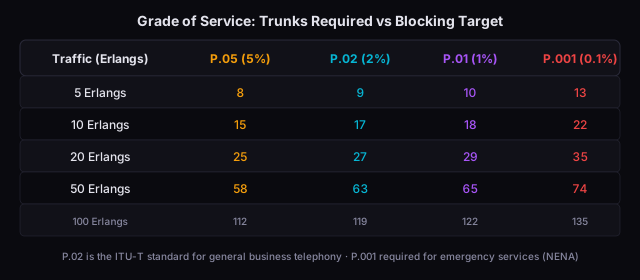
1% blocking cuts the number of blocked calls in half compared to P.02, but requires noticeably more trunks for the same traffic load. For 20 Erlangs of traffic: P.02 needs 27 trunks, P.01 needs 29 trunks — a modest 7% capacity increase for double the reliability.
**When P.01 is appropriate:**
- Critical business lines (revenue-generating inbound lines)
- Financial trading floors
- Healthcare scheduling lines where missed calls have clinical consequences
- Carrier interconnect routes
P.001 — Emergency Services
NENA (National Emergency Number Association) standards for public safety answering points (PSAPs) require blocking probability of P.001 or better — meaning 1 blocked call in 1,000. A missed emergency call can be fatal, so extreme reliability is required.
Planning to P.001 means very high excess capacity. For 20 Erlangs of traffic: 35 trunks are needed at P.001 vs. 27 at P.02. That's 30% more infrastructure for the 20x improvement in blocking probability.
**When P.001 is required:**
- 911/E911 PSAPs
- Emergency services dispatch
- Hospital emergency departments
- Critical infrastructure operations centers
P.05 and Higher — High Blocking Tolerance
Some systems deliberately plan to higher blocking probabilities. P.05 (5% blocking) is used in some off-peak or overflow capacity planning scenarios, and in some developing world telecom networks where capital constraints drive the decision.
**Typically used for:**
- Overflow trunk groups (secondary paths activated only during peaks)
- Rural and developing market network planning
- Non-critical paging and notification systems
How GoS Affects Trunk Count
The relationship between GoS and trunk count is nonlinear. Here's a table for 10 Erlangs of traffic:
| Grade of Service | Required Trunks | Trunks vs P.02 |
|-----------------|----------------|----------------|
| P.05 (5%) | 15 | −2 |
| P.02 (2%) | **17** | baseline |
| P.01 (1%) | 18 | +1 |
| P.001 (0.1%) | 22 | +5 |
For 50 Erlangs:
| Grade of Service | Required Trunks | Trunks vs P.02 |
|-----------------|----------------|----------------|
| P.05 (5%) | 58 | −5 |
| P.02 (2%) | **63** | baseline |
| P.01 (1%) | 65 | +2 |
| P.001 (0.1%) | 74 | +11 |
At high traffic loads, tightening from P.02 to P.001 adds roughly 15–20% capacity cost. That's the price of the reliability improvement.
Use our [Erlang calculator](/erlang-calculator) to see how different GoS targets affect your trunk count for your specific traffic load.
Service Level vs. Grade of Service: Don't Confuse Them
Grade of Service (GoS) is a concept for **Erlang B** (trunk line) systems where blocked calls are cleared.
**Service level** is the equivalent concept for **Erlang C** (call center queuing) systems, where callers wait rather than being blocked. Service level is expressed as "X% of calls answered within Y seconds" — the classic 80/20 means 80% of calls answered within 20 seconds.
These are different measures for different systems. Don't apply GoS terminology to call centers or service level terminology to trunk lines. Our [Erlang B vs Erlang C guide](/blog/erlang-b-vs-erlang-c) has a full explanation of when each applies.
Setting Your GoS Target in Practice
If you're provisioning SIP trunks or PRI lines for a standard business application, start with **P.02**. It's the ITU-T standard, it's what most carriers design to, and it provides a sensible balance of cost and reliability for most applications.
If blocked calls have significant revenue or operational consequences — every inbound call represents a sales opportunity — consider **P.01**. The incremental cost is modest.
If you're working on any life-safety application, consult the relevant standards body (NENA for 911, ETSI for European emergency services) for their specific requirements. Don't guess on GoS for emergency services — it's a regulated parameter.
For detailed calculations at any GoS target, [run the Erlang B calculator](/erlang-calculator) with your traffic parameters.