The 80/20 Service Level Rule: Staff Your Call Center Right
The 80/20 service level rule means 80% of calls answered within 20 seconds. Here's what it actually means, where it came from, and how to staff for it using Erlang C.
> **Quick Answer:** 80/20 service level means 80% of calls answered within 20 seconds. It's the most common contact center target. Achieve it by running Erlang C with your busy-hour traffic, AHT, and these exact parameters — then add 30% shrinkage to get scheduled headcount.
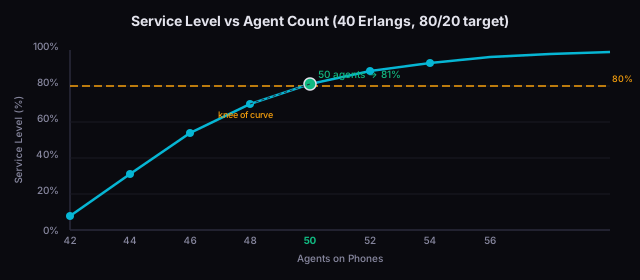
"We target an 80/20 service level" is possibly the most common phrase in contact center management. But many managers who say it can't explain where 80/20 came from, why it's 80% and 20 seconds rather than 90% and 30 seconds, or how many agents they need to hit it. If you're making staffing decisions, you should be able to answer all three.
Where 80/20 Came From
The 80/20 service level standard doesn't come from a regulatory mandate or an ITU-T recommendation. It emerged as an industry norm through the early 1980s when ACD (Automatic Call Distributor) technology first enabled contact centers to measure call waiting times systematically.
The Incoming Calls Management Institute (ICMI) — the leading professional organization for contact center management — helped codify it as a benchmark. At 80/20, most callers perceive the wait as acceptable, abandonment rates are manageable, and the staffing cost is reasonable. Stricter targets (90/15, 95/10) cost significantly more in agent hours; looser targets (70/30, 60/20) can damage customer satisfaction.
It's not a universal standard. Healthcare and financial services often target 90/15 due to customer expectations and regulatory context. Some high-volume, low-complexity operations (airline reservations, retail order lines) run at 70/30 to reduce costs. Emergency services and crisis lines target 95/5 or better.
What 80/20 Actually Means — and What It Doesn't
80/20 means that during any given reporting interval (typically 30 minutes or an hour), 80% of calls are answered by a live agent within 20 seconds. The remaining 20% wait longer.
What it does **not** mean:
- Average speed of answer is 20 seconds (ASA is usually much lower — often 5–8 seconds — because most calls are answered almost immediately and a few wait a long time)
- 20% of callers wait forever or abandon (callers who abandon are usually excluded from service level calculation in most ACD systems)
- The service level is measured in real-time (it's typically measured in 30-minute intervals)
Calculating Agents for 80/20 with Erlang C
Service level = X% of calls answered within Y seconds. The Erlang C formula gives you the probability that a call must wait at all (the wait probability, C(N,A)), and from that derives the probability that a call waits longer than your target time:
**SL = 1 - C(N,A) × e^(-(N-A)(t/AHT))**
Where:
- N = number of agents
- A = traffic intensity in Erlangs
- t = target answer time (20 seconds for 80/20)
- AHT = average handle time in seconds
You find the minimum N where SL ≥ 0.80.
Worked Example
A customer service team handles inbound calls with:
- Busy-hour calls: 480 per hour
- Average handle time (talk + hold + wrap-up): 300 seconds
- Service level target: 80/20
Traffic intensity: A = (480 × 300) / 3600 = **40 Erlangs**
Running Erlang C to find N where SL ≥ 80%:
| Agents (N) | C(N,A) | Service Level |
|------------|--------|---------------|
| 42 | 0.87 | 37% |
| 45 | 0.63 | 58% |
| 48 | 0.38 | 75% |
| **50** | **0.25** | **81%** ✓ |
| 52 | 0.16 | 87% |
**50 agents** gives you 81% service level — just above the 80% target. Agent occupancy: 40/50 = **80%**. That's on the high side; a 5% traffic spike would drop you to ~72% service level.
Going to 52 agents raises service level to 87% and reduces occupancy to 76.9%, giving more buffer for traffic variation. Whether that's worth the cost is a business decision.
[Run your own staffing calculation](/erlang-calculator) with your actual call volume and AHT.
The Staffing Curve: The "Knee" Effect
One of the most important things to understand about Erlang C is that the relationship between agents and service level is not linear — it's S-shaped with a steep "knee."
At very low agent counts (near traffic intensity), adding one agent has a huge effect on service level. As you add more agents, each additional agent has less impact. The knee of the curve is typically around 70–80% agent occupancy.
This means:
- **Under the knee:** You're in the danger zone. Every agent you lose causes a disproportionate service level drop.
- **At the knee:** Each agent added gives meaningful service level improvement at reasonable cost.
- **Above the knee:** Each additional agent gives diminishing returns. The marginal value of the 55th agent when you have 52 is small.
The 80/20 target is deliberately placed near the knee. If your staffing calculations put you in the danger zone (above 85% occupancy), you're operating with no buffer and will consistently miss your target on any day with higher-than-forecast traffic.
From Agents Needed to Agents Scheduled: Shrinkage
Erlang C calculates **agents on phones**. Your schedule needs more people than that because agents have shrinkage:
- Paid breaks (2 × 15 min per 8-hour shift = 6.25%)
- Meal break (typically unpaid, but still affects scheduling)
- Team meetings and briefings (2–5%)
- Training and coaching (3–8%)
- System downtime and non-call work (2–4%)
- Unplanned absence (5–10%)
Total shrinkage typically runs 25–35% in most contact centers.
**Formula:** Scheduled agents = Agents needed / (1 - Shrinkage %)
Using our 50-agent example with 30% shrinkage:
50 / 0.70 = **72 agents to schedule**
That's your FTE (full-time equivalent) requirement for that interval. A 30-person contact center that thinks it needs 50 agents on phones is actually hiring (or rostering) 72 people.
What Happens When You Miss Your Service Level
Missing 80/20 has cascading effects. When calls queue longer:
1. **Abandonment rises** — Callers hang up before being answered, creating re-calls that add more traffic to an already strained system.
2. **Agent stress increases** — Agents under queue pressure tend to handle calls faster, reducing quality, which increases re-calls.
3. **ASA (Average Speed of Answer) blows out** — Even if 65% of calls are answered in under 20 seconds, the ones waiting 5+ minutes pull the ASA up, damaging your CSAT scores.
These feedback loops mean that a service level miss of 10 percentage points (70% instead of 80%) often feels much worse than 10 points would suggest, because abandoned callers call back and further increase your traffic load.
For help with the staffing calculation, use our [Erlang C calculator](/erlang-calculator). For common mistakes to avoid, our [7 Erlang calculation mistakes](/blog/common-erlang-mistakes) guide covers the errors that consistently cause staffing models to fail.